Overview
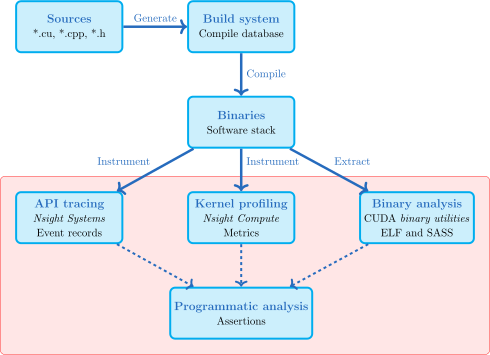
ReProspect provides a framework for reproducible prospecting of CUDA applications. It is implemented in Python and builds on the NVIDIA tools: Nsight Systems for API tracing [NVIb], Nsight Compute for kernel profiling [NVIa], and the CUDA binary utilities for binary analysis [NVIe].
ReProspect provides an interface to launch these NVIDIA tools, as well as post-processing utilities to collect the results in tailored data structures. It also provides assertion functions to verify that the collected data match expectations.
ReProspect allows the entire prospecting workflow to be encoded in a Python script, thus making it reproducible, integrable into automated workflows, as well as easily shareable. One of the objectives of ReProspect is to allow new use cases for CUDA code prospecting to be developed and explored, such as the integration of such analyses in CI/CD pipelines and their increased use in collaborative code reviews to help motivate development decisions.
ReProspect supports three complementary forms of analysis:
Built on top of Nsight Systems (
nsys) to record various runtime events, such as CUDA API calls, and examine application-level control flow.Built on top of Nsight Compute (
ncu) to collect detailed per-kernel runtime metrics.Built on top of the CUDA binary utilities (
cuobjdumpandnvdisasm) to extract information from CUDA binaries, such as the SASS instructions that make up a kernel, the associated control flow instructions, the resource usage, and so on. Notably,reprospect.testing.binaries.sassprovides matchers to validate the presence of specific instruction patterns in SASS code.
In order to facilitate its integration in CI/CD pipelines, ReProspect has functionalities to interact with the build system, such as functionalities to obtain information about the compiler toolchain. Currently, these functionalities have been implemented only for the CMake build system.
The main steps in a typical ReProspect case are illustrated in the following schematic (see also Analysis workflow):
The ReProspect repository includes several examples relevant to the Kokkos [kok] performance portability library, and in particular its CUDA backend. These examples demonstrate ReProspect capabilities by examining several specific implementation details of Kokkos.